Hi everyone!!!
How are you all???
Now this post is fully dedicated to my hometown Madurai :-)
Madurai is the third largest city in Tamil Nadu.
My city is also called as Temple City, as there are many temples here!!!
It is also called as Thoongaa Nagaram (eng: A city that doesn't sleep). Even if you come at midnight, you will have lots of hotels to provide food!!!
Madurai is also called as City of Four Junctions (Koodal Maanagar), Cultural Center of Tamil Nadu (Kalaachaara Thalainagar), City of Jasmine (Malligai Maanagar) and The City of Festivals (Thiruvizha nagaram). The city got its name from Sanskrit word "Mathura", which means "sweetness".
Here are the some of the famous places in Madurai:
MEENAKSHI AMMAN TEMPLE:

The enormous temple complex is dedicated to Shiva, known here as Sundareshvara and his consort Parvati or Meenakshi. The original temple was built by Kulasekara Pandya, but the entire credit for making the temple as splendid as it is today goes to the Nayaks. The Nayaks ruled Madurai from the 16th to the 18th century and left a majestic imprint of their rule in the Meenakshi - Sundareswarar Temple.
The temple complex is within a high-walled enclosure, at the core of which are the two sanctums for Meenakshi and Sundareshwara, surrounded by a number of smaller shrines and grand pillared halls. Especially impressive are the 12 gopuras. Their soaring towers rise from solid granite bases, and are covered with stucco figures of dieties, mythical animals and monsters painted in vivid colors.
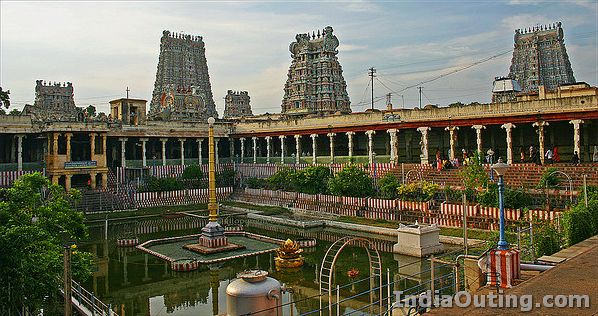
There are 12 temple towers(Gopurams). The outer towers are the landmarks of Madurai. They are:
East Tower (Nine Storeys). Height 161'3". This Gopura has 1011 sudhai figures.
South Tower (Nine Storeys). Height 170'6". This Tower has 1511 sudhai figures.
West Tower (Nine Storeys). Height 163'3". This Tower has 1124 sudhai figures.
North Tower (Nine Storeys). Height 160'6". This Tower has lesser figures of sudhai than other outer towers.


Meenakshi Amman temple has a Golden Lotus:
Potramarai Kulam (Golden Lotus Tank), the sacred pond inside the Meenakshi Sundareswarar Temple is a very holy site for the devotees and people go around the lake before entering the main shrine. The etymology for the word means, the Pond with the Golden Lily and as the Lily that grows in it has a golden color. According to the legend, Lord Shiva promised to a stork that no fish or other marine life would grow here and thus no marine animals are found in the lake. In the Tamil legends, the lake is supposed to be a judge for judging a worth of a new literature. Thus, authors place their works here and the poorly written works are supposed to sink and the scholastic ones are supposed to float.

THIRUMALAI NAYAK PALACE:

MARIAMMAN TEPPAKULAM:

Vandiyur Mariamman Teppakulam is situated at a distance of about 5 km from the Meenakshi Amman Temple. The area of the tank, and the island pavilion with a garden in the center, is approximately equal to the area of Meenakshi Temple. It is one of the largest temple tanks in South India and gets water supply from the Vaigai River. There is a Vinayakar temple situated right in the middle of the tank, which is dedicated to Lord Vigneshwara, the Elephant-faced God.
According to mythology, earth was dug out from the tank to build the Tirumalai Nayakkar Mahal. The place was supposed to be blessed and was later converted into a Teppakulam (tank). The tank is connected to Vaigai River via underground channels. It has total of 12 long stairs (steps) made of granite on all four sides. The temple as well as the stairs was built by the King Thirumalai Nayak.
Mariamman Teppakulam is famous for the celebrations of the Float festival, which is celebrated in the Tamil month of Thai. The festival commemorates the birthday of King Thirumalai Nayak. The celebrations take place on a full moon night and the pristine water turns colourful as the temple is lit. The deities of the temple come down to the tank in colorful floats, presenting a mesmerizing sight. Pilgrims across India come to Madurai to participate in the festival.

GANDHI MEMORIAL MUSEUM :
One of the five Gandhi Sanghralayas in India.
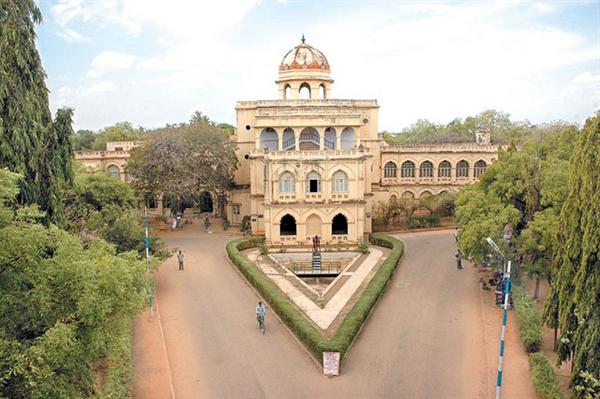
Once the place of Rani Mangammal of the Nayak dynasty, this palatial building now houses the Madurai chapter of Gandhi Museums in India. The palace was built in 1670 by the Nayak rulers and changed hands between the Nawab of Carnatic and the East India Company, among others. It was only in 1955 that the State Government of Tamil Nadu gifted this property to the All India Gandhi Smarak foundation, with about 13 acres of land in tow.
The museum now houses a brilliantly stocked library, with a lot of options for some excellent academic research. They also run the popular and prestigious Gandhi Memorial Lecture Series from time to time, inviting scholars to present research papers. The museum is also home to wonderful galleries, each dedicated to a different strand of Indian history. These galleries include "India Fights for Freedom", "Visual Biography of Mahatama Gandhi" and "Relics and Replicas". The ground floor of the museum also houses a unique collection of stamps and letters at the Philatelic Museum, dedicated to Gandhi.

VAIGAI RIVER:
Vaigai river is an important river flowing in Madurai. All the major water supply schemes in Madurai district have been formulated with Vaigai river as a source. Illango Adigal has referred to the river Vaigai as a perennial river which brought all wealth to Madurai and happiness to all human beings in and around her.
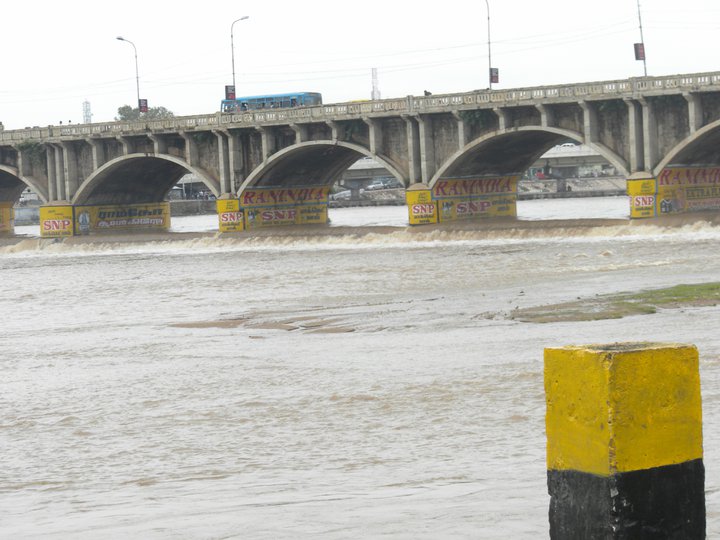
The river is closely associated with the Chithirai festival of Meenakshi Sundareswarar temple at Madurai. On Chitra Pournami day Lord Kallazhagar (Vishnu), the elder brother of Goddess Meenakshi enters the Vaigai River. Legend has it that the festival is held to re-enact a puranic episode in which Lord Azhagar comes to the riverbank from his abode at Azagarmalai (30 kms from Madurai) to grant moksha to ‘Mandooka’ Rishi who was a great devotee of Vishnu, but was cursed earlier to turn into a frog.
According to another legend, Kallazhagar arrived late for the marriage of his sister Meenakshi with Lord Sundareshwara. Taking note that the marriage has already taken place, he plunges into the river Vaigai and walks through to nearby Vandiyur. Adults and children join together in spraying water at Lord Kallazhagar as he walks towards the river bank of Vaigai in total disappointment.
THIRUPARANGKUNDRAM:


SAINT MARY'S CATHEDRAL:

Fr. Bertrend SJ, bought a piece of land in 1840 and a mini chapel dedicated to our Lady of Dolours was constructed in 1841 by Fr. Garnier. He settled down nearly 30 families of Saliers who were persecuted and driven out from W. Pudupatti church. During the period of Fr. Trincal, (1855) the number of Catholics in this area rose from 600 to 2500. To accommodate the Catholics, the Church was expanded by Fr. Hibolite sj and Br. Lemothe, sj who built two bell towers in Roman style about 1972. The Church was extended to the present Gothic style in three parts. Due to lack of fund from Europe caused by World War I in 1914, Fr. Planchard had to sell the land (the present Mission Hospital opposite to the Cathedral) and continue the construction. The work was over in 1916 and Msgr. Faisandier blessed the church on 15th of August. Mr. Savarimuthu, who built St. Joseph’s College buildings was the architect of the Cathedral. When Madurai was created as a new diocese, Msgr. Leonard sj. announced Our Lady of Dolours as Pro-Cathedral.
From the beginning, this Church is one of the attractions of Madurai. This parish is more than 150 years old. The parish is full of traditional Catholics and some settled Catholics. The parish comprises of fifteen sub stations and 1600 Catholic Families.

After Fr. Gomez sj, Fr. Adaikalam sj. executed the plan of the present bigger church and the taller towers. At the time of Msgr. Justin Diraviam, Our Lady of Dolours attained the status of a Cathedral and was handed over to the Archdiocese in virtue of the Decree given by the Sacred congregation for Religious and seular institutes in 1969. The Cathedral church stands as a unique symbol of beauty and spirituality with a blend of various forms of European, Roman and continental architecture. The spiritual aura of the agony of Jesus and Mary inspires pathos and passion.

PUDHU MANDAPAM:

This mandapam was built by Thirumalai Nayakkar. Vasanthosavam – the spring festival-is celebrated in this mandapam in Vaikasi (April/May). Its pillars contain elaborate sculptures of Shiva, Meenakshi, scenes from their wedding as well as the figures of ten of the Nayak Kings and their consorts. This is also called Pudhu Mandapam.
Opposite the eastern side of Sree Meenakshi Temple is the Puthu Mandapam. It was built by Thirumalai Nayakkar for Lord Sundareswarar. The hall is 330 feet long and 105 feet broad over the plinth. It is 25 feet high with 124 pillars of four rows. On either side of the central corridor of this hall there are imposing pillars having the figures of 14 of the Naik rulers including Thirumalai Nayakkar. The date of construction of the Pudu Mandapam is known to be 1628-35. Hence it forms as the Vasantha Mandapam. There are book shops on the northern side and vessel shops on the southern side.

Finally My Madurai is the best!!!
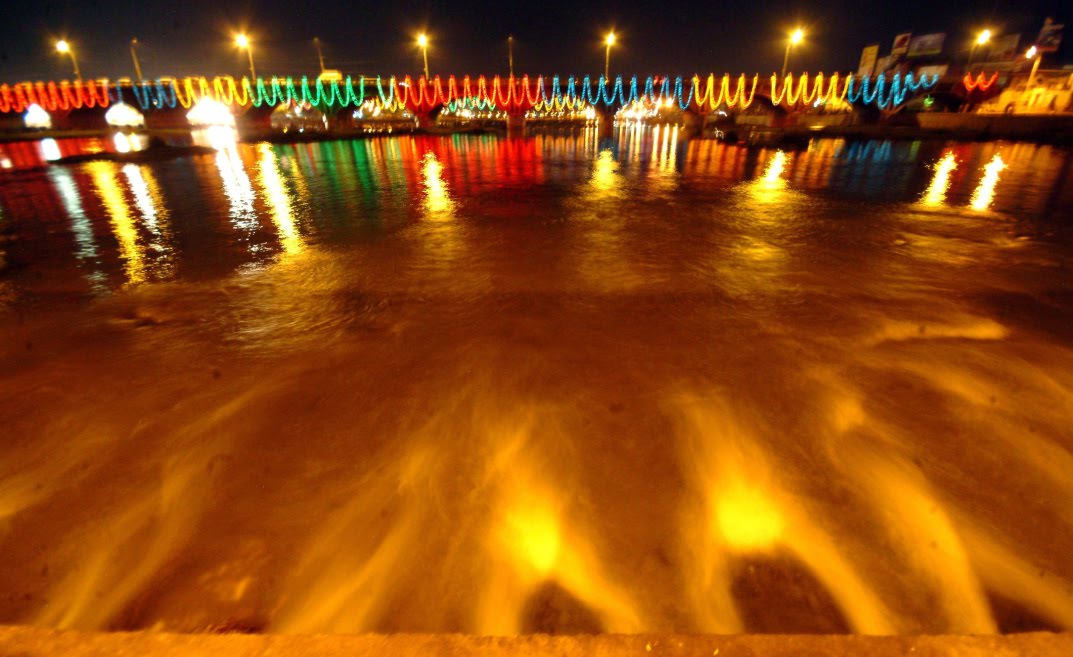
Here are some of my city's pictures at night:


Come and visit my city!!!
You will love it!!!
How are you all???
Now this post is fully dedicated to my hometown Madurai :-)
Madurai is the third largest city in Tamil Nadu.
My city is also called as Temple City, as there are many temples here!!!
It is also called as Thoongaa Nagaram (eng: A city that doesn't sleep). Even if you come at midnight, you will have lots of hotels to provide food!!!
Madurai is also called as City of Four Junctions (Koodal Maanagar), Cultural Center of Tamil Nadu (Kalaachaara Thalainagar), City of Jasmine (Malligai Maanagar) and The City of Festivals (Thiruvizha nagaram). The city got its name from Sanskrit word "Mathura", which means "sweetness".
Here are the some of the famous places in Madurai:
MEENAKSHI AMMAN TEMPLE:
The enormous temple complex is dedicated to Shiva, known here as Sundareshvara and his consort Parvati or Meenakshi. The original temple was built by Kulasekara Pandya, but the entire credit for making the temple as splendid as it is today goes to the Nayaks. The Nayaks ruled Madurai from the 16th to the 18th century and left a majestic imprint of their rule in the Meenakshi - Sundareswarar Temple.
The temple complex is within a high-walled enclosure, at the core of which are the two sanctums for Meenakshi and Sundareshwara, surrounded by a number of smaller shrines and grand pillared halls. Especially impressive are the 12 gopuras. Their soaring towers rise from solid granite bases, and are covered with stucco figures of dieties, mythical animals and monsters painted in vivid colors.
There are 12 temple towers(Gopurams). The outer towers are the landmarks of Madurai. They are:
East Tower (Nine Storeys). Height 161'3". This Gopura has 1011 sudhai figures.
South Tower (Nine Storeys). Height 170'6". This Tower has 1511 sudhai figures.
West Tower (Nine Storeys). Height 163'3". This Tower has 1124 sudhai figures.
North Tower (Nine Storeys). Height 160'6". This Tower has lesser figures of sudhai than other outer towers.
Meenakshi Amman temple has a Golden Lotus:
Potramarai Kulam (Golden Lotus Tank), the sacred pond inside the Meenakshi Sundareswarar Temple is a very holy site for the devotees and people go around the lake before entering the main shrine. The etymology for the word means, the Pond with the Golden Lily and as the Lily that grows in it has a golden color. According to the legend, Lord Shiva promised to a stork that no fish or other marine life would grow here and thus no marine animals are found in the lake. In the Tamil legends, the lake is supposed to be a judge for judging a worth of a new literature. Thus, authors place their works here and the poorly written works are supposed to sink and the scholastic ones are supposed to float.
The hall of thousand pillars(Ayiramkal Mandapam):
The largest mandapam in the holy temple complex, this mandapam is situated near Veeravasantharayar Mandapam to the north. This was built by Ariyanatha Mudaliyar, minister and commander of Viswanatha Naicker in the year 1569.
This Mandapam has a total of 985pillars. These pillars have been so arranged that from whatever angle one looks from within, the pillars look in rows and rows.
At the centre of the mandapam is the idol of Chira Sabha of Lord Natarajar.
There is an idol of a hero on a horse at the entrance to the Mandapam facing south. Legend has it that this is an idol of Ariyanatha Mudaliyar who built the mandapam. But this is a sacred idol of Lord Sundareswarar who on behalf of Saint Manickavasagar converted foxes into horses.
To east of the idol of the deity on the horseback, are sculptures of Kannapar, Lord Siva destroying an asura and Pichadanar.
At the eastern entrance there are statues of a hero on a horseback, Harichandra, gypsy man and woman with a child in arms, woman (Chandramathi, wife of Harichandra).
Carved on eight pillars next to the entrance are statues of Thiripurandhakar, Nirutha Ganapathy with an urn containing ambrosia, Lord Muruga on peacock, Nagaraja, Saraswathy, Hunter, as well as that of two Dwarapalakars.
In the area next to the entrance, there are idols of Thirumal, Arjuna in the form of a eunuch, and Draupadhi. There is also a statue of a man carrying a woman. This is said to represent the nature of Kaliyuga, depicting that man was a serf of woman. In the pillars in between there are carvings of yalis.
At foot of the pillars, along the centre of the mandapam are carved sculptures of Pitchadanar, Dharman, Beeman, Rathi and Veerpathirar while at the top are carvings of Agni, Veerapathirar, Manmadan, Purushamirukam, Arjunan and Mohini. Among these sculptures is one of Rathi seated on a Swan, which are quintessence of the art of sculpture with musical notes.
The pillars at the beginning and end of the row are big ones with small circular blocks and the one at the bottom could be rolled. These pillars are called musical pillars and they produce musical notes when tapped.
At the roof of the entrance are sculptures representing the 60 years in the Tamil calendar.
THIRUMALAI NAYAK PALACE:
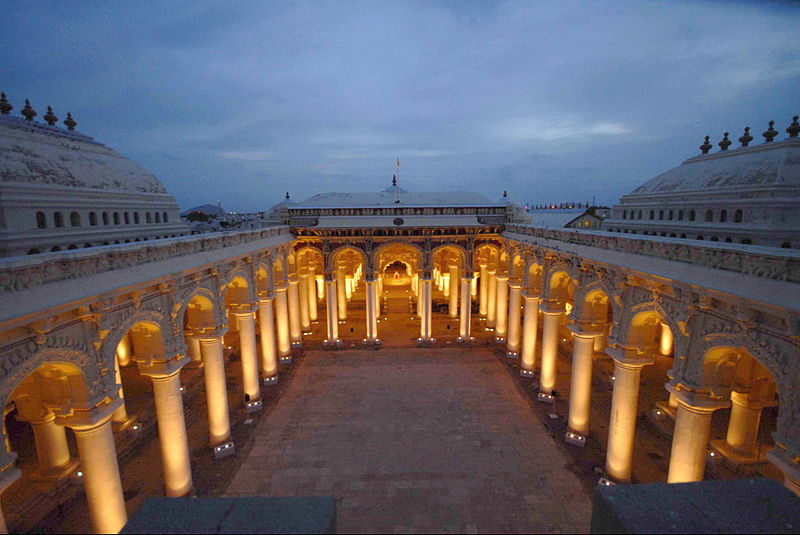
Also known as the Thirumalai Nayakkar Mahal, this magnificent palace dates back to 1636. Built by the Nayak king, Thirumalai Nayak, the palace is a curious blend of Dravidian and Islamic styles of architecture. It was built as a residence for the king of the Nayak kindgom when their capital was at Madurai.
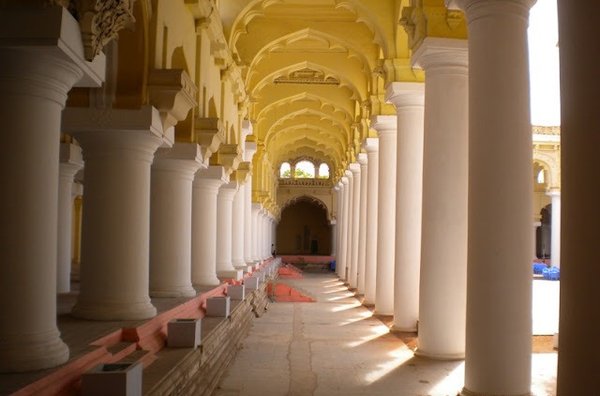
The palace is famous for its impressive arches and ""stuccowork"" on its domes. The austere exteriors offset the palatial interiors, with tall, white pillars lining the corridors. These pillars are a characteristic feature of the place, at 20 m high and 4 m in circumference. It was stripped off much of its grandeur by Thirumalai Nayak's grandson, who took away most of the woodcarvings and jewels to build a palace for himself in Tiruchirapalli, though he was never successful in that endeavour. Currently, the palace exists in its present glory thanks to the efforts of Lord Napier, the British Governor of Madras, who renovated the palace between 1866 and 1872.
The complex now runs a sound and light show every evening to explain about the history of the palace and Thirumalai Nayak, praising his work as a ruler for the benefit of his subjects.
The grandeur of King Thirumalai Nayak’s Palace, built in 1636, is still evident. It is a beautiful structure, with a massive courtyard, surrounded by corridors lined with sculpted pillars that rise 40 ft high. There is an interesting museum inside.
The grandeur of King Thirumalai Nayak’s Palace, built in 1636, is still evident. It is a beautiful structure, with a massive courtyard, surrounded by corridors lined with sculpted pillars that rise 40 ft high. There is an interesting museum inside.
MARIAMMAN TEPPAKULAM:
Vandiyur Mariamman Teppakulam is situated at a distance of about 5 km from the Meenakshi Amman Temple. The area of the tank, and the island pavilion with a garden in the center, is approximately equal to the area of Meenakshi Temple. It is one of the largest temple tanks in South India and gets water supply from the Vaigai River. There is a Vinayakar temple situated right in the middle of the tank, which is dedicated to Lord Vigneshwara, the Elephant-faced God.
According to mythology, earth was dug out from the tank to build the Tirumalai Nayakkar Mahal. The place was supposed to be blessed and was later converted into a Teppakulam (tank). The tank is connected to Vaigai River via underground channels. It has total of 12 long stairs (steps) made of granite on all four sides. The temple as well as the stairs was built by the King Thirumalai Nayak.
Mariamman Teppakulam is famous for the celebrations of the Float festival, which is celebrated in the Tamil month of Thai. The festival commemorates the birthday of King Thirumalai Nayak. The celebrations take place on a full moon night and the pristine water turns colourful as the temple is lit. The deities of the temple come down to the tank in colorful floats, presenting a mesmerizing sight. Pilgrims across India come to Madurai to participate in the festival.
GANDHI MEMORIAL MUSEUM :
One of the five Gandhi Sanghralayas in India.
Once the place of Rani Mangammal of the Nayak dynasty, this palatial building now houses the Madurai chapter of Gandhi Museums in India. The palace was built in 1670 by the Nayak rulers and changed hands between the Nawab of Carnatic and the East India Company, among others. It was only in 1955 that the State Government of Tamil Nadu gifted this property to the All India Gandhi Smarak foundation, with about 13 acres of land in tow.
The museum now houses a brilliantly stocked library, with a lot of options for some excellent academic research. They also run the popular and prestigious Gandhi Memorial Lecture Series from time to time, inviting scholars to present research papers. The museum is also home to wonderful galleries, each dedicated to a different strand of Indian history. These galleries include "India Fights for Freedom", "Visual Biography of Mahatama Gandhi" and "Relics and Replicas". The ground floor of the museum also houses a unique collection of stamps and letters at the Philatelic Museum, dedicated to Gandhi.
VAIGAI RIVER:
Vaigai river is an important river flowing in Madurai. All the major water supply schemes in Madurai district have been formulated with Vaigai river as a source. Illango Adigal has referred to the river Vaigai as a perennial river which brought all wealth to Madurai and happiness to all human beings in and around her.
The river is closely associated with the Chithirai festival of Meenakshi Sundareswarar temple at Madurai. On Chitra Pournami day Lord Kallazhagar (Vishnu), the elder brother of Goddess Meenakshi enters the Vaigai River. Legend has it that the festival is held to re-enact a puranic episode in which Lord Azhagar comes to the riverbank from his abode at Azagarmalai (30 kms from Madurai) to grant moksha to ‘Mandooka’ Rishi who was a great devotee of Vishnu, but was cursed earlier to turn into a frog.
According to another legend, Kallazhagar arrived late for the marriage of his sister Meenakshi with Lord Sundareshwara. Taking note that the marriage has already taken place, he plunges into the river Vaigai and walks through to nearby Vandiyur. Adults and children join together in spraying water at Lord Kallazhagar as he walks towards the river bank of Vaigai in total disappointment.
THIRUPARANGKUNDRAM:
The devotion to Lord Murugan (or Subramanya), the son of Lord Shiva, is central to the cultural fabric of Tamil Nadu. He represents war and patriotism and is often known as the patron god of the region. The Murugan Temple at Thiruparankundram is an example of this cult of devotion, one of the 6 most important pilgrimage sites for Hindu devotees of the deity. Situated atop a scenic hill in Thiruparankundram, this temple and the surrounding region is rich with its own share of myth and legends.
According to myths and local folklore, Murugan came to this hill after fighting the 6 battles against 'evil' rakshasas (demons), to finally save the heavens from the rakshasa, Soorapadman. It is here that he married Goddess Deivayanai, the daughter of Lord Indra, who was given to him as a reward for his victory of evil forces. It is this strand of the myth that makes the temple a popular and sacred marriage location, especially during the festival of marriages, Pankuni Uttiram, held towards the latter half of March every year.
The complex is rock-cut and is built along the caves here, lending the place its historic aura. It is believes that during the reign of the Pandyas and the Nayaks, between 16th and 18th centuries, the temple got its beautiful gopurams (or gateways) and pillars carved intricately with the lotus-pattern. One can also find inscriprions on the walls here that showcase the history of the temple. The presiding deities here are Lord Murugan and Goddess Deivayanaii, while other idols dedicated to Lord Shiva, Ganesha, Vishnu and Goddess Durga are also housed here.
If this aspect of history wasn't sufficient, there also exists a dargah dedicated to Sikander, or Alexander The Great, who was believed to be a friend of King Murugan.
SAINT MARY'S CATHEDRAL:
Fr. Bertrend SJ, bought a piece of land in 1840 and a mini chapel dedicated to our Lady of Dolours was constructed in 1841 by Fr. Garnier. He settled down nearly 30 families of Saliers who were persecuted and driven out from W. Pudupatti church. During the period of Fr. Trincal, (1855) the number of Catholics in this area rose from 600 to 2500. To accommodate the Catholics, the Church was expanded by Fr. Hibolite sj and Br. Lemothe, sj who built two bell towers in Roman style about 1972. The Church was extended to the present Gothic style in three parts. Due to lack of fund from Europe caused by World War I in 1914, Fr. Planchard had to sell the land (the present Mission Hospital opposite to the Cathedral) and continue the construction. The work was over in 1916 and Msgr. Faisandier blessed the church on 15th of August. Mr. Savarimuthu, who built St. Joseph’s College buildings was the architect of the Cathedral. When Madurai was created as a new diocese, Msgr. Leonard sj. announced Our Lady of Dolours as Pro-Cathedral.
From the beginning, this Church is one of the attractions of Madurai. This parish is more than 150 years old. The parish is full of traditional Catholics and some settled Catholics. The parish comprises of fifteen sub stations and 1600 Catholic Families.
After Fr. Gomez sj, Fr. Adaikalam sj. executed the plan of the present bigger church and the taller towers. At the time of Msgr. Justin Diraviam, Our Lady of Dolours attained the status of a Cathedral and was handed over to the Archdiocese in virtue of the Decree given by the Sacred congregation for Religious and seular institutes in 1969. The Cathedral church stands as a unique symbol of beauty and spirituality with a blend of various forms of European, Roman and continental architecture. The spiritual aura of the agony of Jesus and Mary inspires pathos and passion.
PUDHU MANDAPAM:
This mandapam was built by Thirumalai Nayakkar. Vasanthosavam – the spring festival-is celebrated in this mandapam in Vaikasi (April/May). Its pillars contain elaborate sculptures of Shiva, Meenakshi, scenes from their wedding as well as the figures of ten of the Nayak Kings and their consorts. This is also called Pudhu Mandapam.
Opposite the eastern side of Sree Meenakshi Temple is the Puthu Mandapam. It was built by Thirumalai Nayakkar for Lord Sundareswarar. The hall is 330 feet long and 105 feet broad over the plinth. It is 25 feet high with 124 pillars of four rows. On either side of the central corridor of this hall there are imposing pillars having the figures of 14 of the Naik rulers including Thirumalai Nayakkar. The date of construction of the Pudu Mandapam is known to be 1628-35. Hence it forms as the Vasantha Mandapam. There are book shops on the northern side and vessel shops on the southern side.
Finally My Madurai is the best!!!
Here are some of my city's pictures at night:
Come and visit my city!!!
You will love it!!!
No comments:
Post a Comment